Introduction: Vision into Interactive Reality
The gaming industry has grown to become a strong digital ecosystem with innovation, performance, and scalability as the key factors of success. The process of developing a mobile game, enterprise simulation or an immersive 3D or VR experience involves strategic planning and technical skills to go through the process of idea to launch.
By collaborating with a Unity Game Development Company, your project will be transferred to a high performance product without any hitches. The ability of Unity to be flexible, cross-platform, and to have a strong development environment is one of the strongest engines in the gaming industry today.
This paper discusses the entire development process – in terms of performance, scalability, and overall business value.
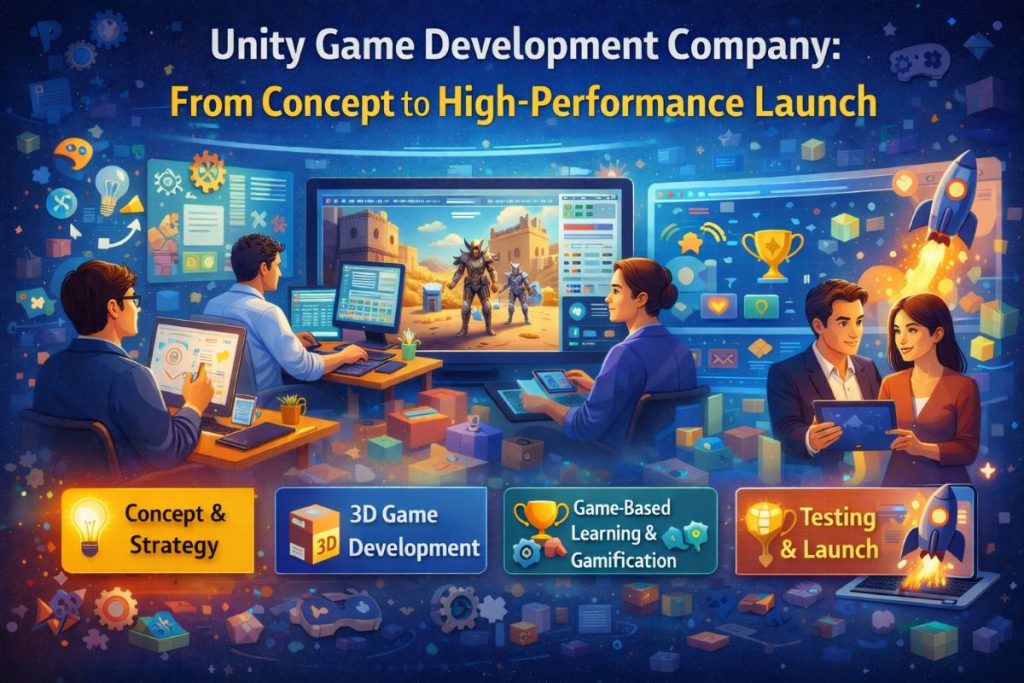
Phase 1: Concept Strategy and Market Validation
Any winning game has a vision. Not ideas only are sufficient. It is strategic validation that will make a concept into a viable product.
At this point, the following is included:
- Determining the target audience
- Studying competitors
- Specifying gameplay mechanic
- Features correspondence to business objectives
- Designing the monetisation strategies
A professional staff makes sure that the idea of the game is not only creative but also a viable commercial idea. Through market research, it is possible to know what players anticipate and how your product would be exceptional.
The basis mitigates risks and preconditions for a scalable launch.
Phase 2: Game Design and Technical Architecture
Once this has been validated, the second step relates to the formulation of a robust design and technical blueprint.
Key Design Features entail:
- Game mechanics
- User interface (UI)
- User experience (UX)
- Level design
- Character development
- Visual identity
Unity enables programmers to develop games, both 2D and 3D, with high levels of flexibility. This is the stage where performance optimization planning takes place at an early stage. Asset, rendering pipeline and scripting architecture decisions have a direct relationship with the quality of the output.
An organized architecture is a guarantee that it provides:
- Smooth gameplay
- Faster load times
- Lower memory usage
- Improved compatibility of devices
This stage of performance planning avoids expensive remedies in the future.
Phase 3: Development and Iteration Testing (Agile)
Contemporary game development is agile. Teams make and test rather than testing at the conclusion of a project.
The development priorities are to be highlighted as:
- Optimized C# scripting Clean
- Asset integration
- Animation systems
- Physics implementation
- Multiplayer configuration (where necessary)
- Backend integration
Regular testing ensures:
- Bug-free gameplay
- Balanced mechanics
- Consistent inter-device functionality
- Reduced crash rates
Performance testing on Android, iOS, PC, and other systems can be tested to ensure the cross-platform functionality is smooth. The Unity engine is scalable and is therefore suitable to use in deploying multi-devices.
Phase 4: Optimization of High Performance
It is not enough to have a game that is beautiful to look at. User retention is performance based.
Optimization focuses on:
- Reducing draw calls
- Effective compression of assets
- Memory management
- Frame rate stabilization
- Shaders and light optimization
- Multiplayer scalability on the cloud
A high-performance game loads fast, is smooth and offers an interactive experience. This directly improves:
- User engagement
- Session duration
- Player retention
- App store ratings
The competitive advantage in the current oversaturated market is technical efficiency.
Phase 5: Integration of Strategic Learning and Engagement
Outside entertainment, Game Based Learning And Gamification is more often utilized in businesses to develop meaningful interaction in education, corporate settings, and marketing campaigns.
By unity integration is possible:
- Reward systems
- Progress tracking
- Interactive simulations
- Mechanisms of real time feedback
Gamification improves motivation and engagement. It reinforces training results of employees in the corporate context. It enhances retention in education. In the case of brands, it develops a higher interaction with customers.
Organisations tap in to quantifiable effects by aligning the gameplay and learning or business objectives.
Phase 6: Recruiting Specialised Skills to Pinpoint Performance
Experience of a team of developers is very crucial in the quality of a game. A large number of companies prefer to recruit Unity 3D Developer specialists in order to reinforce their projects.
Experts in development are a source of:
- 3D modeling experience
- AR/VR integration skills
- Knowledge of multiplayer system
- Knowledge in performance optimization
- Plug-in development abilities
The recruitment of seasoned talent will guarantee that the project is efficient, expandable, and in accordance with the current gaming standards. It also lowers the maintenance expenses of long term maintenance through avoiding the architectural defects.
Phase 7: Pre-Launch Test and Quality Control
Quality assurance is very strict prior to the roll out making sure that the product matches technical specifications and user expectations.
Testing includes:
- Functional testing
- Testing of compatibility of devices
- Performance stress testing
- Security validation
- Multiplayer load testing
Beta testing by the users is also important. Latest feedbacks will give what is considered valuable insight on:
- Gameplay balance
- User interface clarity
- Engagement levels
- Monetization effectiveness
The systematic process of QA eliminates the negative reviews upon launching the product and safeguards the brands.
Phase 8: Strategy Launch and Deployment
Publishing the game to an app store is not the only part of a high-performance launch.
Such crucial elements of launching are:
- App store optimization (ASO)
- Co-ordination of marketing campaigns
- Influencer partnerships
- Analytics integration
- Cloud scaling preparation
Unity helps to deploy on more than one platform using a single codebase. This saves on time-to-market and generates more revenue potential.
Strategic launch will guarantee visibility, downloads and future growth.
Phase 9: Post Launch Support and Constant Improvement
Game development does not stop at the launch. To be successful long-term, one needs to be supported.
Post launch services will consist of:
- Regular updates
- Feature enhancements
- Bug fixes
- Content expansion
- Improved performance provided by analytics
Evidence-based decision-making assists to enhance retention and monetization plans. Constant optimization is to make sure that the game is developed as well as the user expectations.
The reason why Businesses prefer Macrobian Games
Macrobian Games is a blend of creativity, technical skills and performance-based strategy in order to provide scalable solutions. Since the initial ideation and final optimization after launch, business growth and engagement with the users are considered.
Businesses are able to achieve by matching development with quantifiable results:
- Faster time to market
- Higher user retention
- Improved monetization
- Cross-platform scalability
- Long-term ROI
Conclusion: Constructing Performance, Growth, and Impact
In order to develop an effective game, one will require more than a brilliant idea. It demands systematic planning, streamlined development, tactical implementation and constant enhancement.
It has the ability to implement all the steps, such as concept validation, performance optimization, etc. with precision with the right expertise. The outcome is not merely a game, but a scalable digital product, which is meant to provide engagement, growth, and quantifiable returns.
Innovation is profitable when strategy is through performance.