
TL;DR
- A feature launch and developer adoption are two separate events, and documentation and content fill the gap between them.
- Developers evaluate a feature by reading its documentation before they ever open a dashboard, so unclear or missing docs kill adoption before a demo call happens.
- Good documentation reduces support load and shortens time-to-first-success, the two metrics that predict long-term retention.
- Content, blog posts, guides, and comparisons do the job of getting developers to the documentation in the first place. Docs alone can't drive discovery.
- Teams that treat documentation and content as launch-day afterthoughts consistently see slower adoption curves than teams that build both alongside the feature itself.
Shipping a feature is an engineering milestone. Developers actually using that feature is a separate outcome, and the two rarely land on the same day. Somewhere between "the code is merged" and "developers are running it in production," a feature either gets picked up or quietly ignored. This piece, drawing on patterns seen across DevTool and B2B SaaS launches, walks through why that gap exists, what actually closes it, and how documentation and content work together to turn a shipped feature into an adopted one.
Why Shipping a Feature Doesn't Guarantee Developer Adoption
Product teams tend to measure a launch by what got deployed, not by what got understood. A feature can be technically complete, fully tested, and live in production, and still see near-zero usage in its first month. In most cases, that's not a product problem. It's a discovery and comprehension problem.
Developers don't adopt a new feature the way consumers adopt a new app button. Before writing a single line of integration code, a developer reads the documentation, checks whether the API or CLI command fits into how their stack already works, and decides whether the integration effort is worth it. If that research phase hits a dead end, a missing parameter, an outdated code sample, or a docs page that hasn't been published yet, most developers won't file a support ticket asking for help. They'll close the tab and move on to a competing tool or a workaround they already trust.
This is what makes the launch-to-adoption gap so easy to miss internally. Engineering sees a merged pull request and a green deploy pipeline. Developers on the outside see an undocumented endpoint they have no reason to trust yet.
The Three Places Where Adoption Quietly Breaks Down
Across most product launches, the gap tends to open up in one of three spots:
- Discovery. The feature exists, but nothing outside the changelog tells developers it's there or why it matters to them specifically.
- Comprehension. A developer finds the feature but can't tell from the docs whether it solves their exact problem, or how to wire it into their existing setup.
- First success. A developer starts the integration but hits friction, an unclear error message, a missing code sample, an assumption the docs never spelled out, and abandons it before reaching a working state.
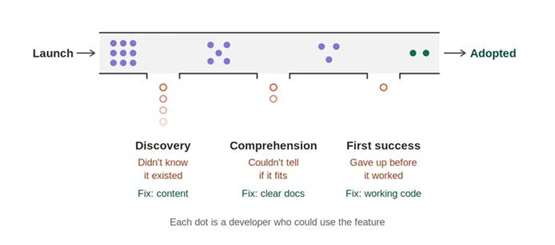
Illustrative example — each dot represents a developer who could use the feature; most drop out before adoption, and each drop-off point has a different fix.
Each of these failure points has a different fix, but all three point back to the same root cause: the writing around the feature wasn't built with the same rigor as the feature itself.
Documentation Is the First Real Interaction Developers Have With a Feature
For technical readers, the documentation serves as a demonstration of the product. When a developer is looking at a new API endpoint or SDK method, they read the reference page, carry out the sample request, and then form an opinion concerning the overall quality of the product all within that one interaction, well before speaking to sales or watching a walkthrough video. The first impression they form is largely determined by whether the documentation works on the first attempt.
Documentation quality therefore becomes a direct advantage to be taken up, not a support cost center that has to be minimized. If a page includes working code, clear explanations of the parameters, and a realistic example of use, it will bring a developer to a successful first call within minutes. On the other hand, if the page has placeholder text, an out-of-date example, or a response schema that does not match what the API actually returns, it will cause that developer to go back to the search results, often permanently. Once the documentation has let a developer down, they rarely give the product another chance.
Groups which regard documentation as a one-off engineering job, writing it once during the sprint, releasing it and then moving on, generally end up with reference material which is technically accurate but in reality very difficult to use. On the other hand, groups that consider documentation to be a special skill and apply the same design care to onboarding processes or error messages consistently achieve a shorter time to their first successful call and have fewer 'how do I even start' questions in their support queue.
What Separates Documentation That Drives Adoption From Documentation That Doesn't
Documentation that actually moves developers from curious to integrated tends to share a specific set of traits, regardless of the product category:
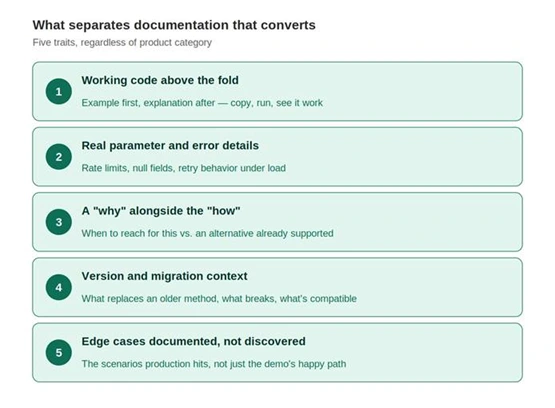
None of this is exotic advice. It's the practical difference between documentation written by someone summarizing a pull request description and documentation written by someone who actually ran the code end to end, including the failure paths.
This is precisely the gap that dedicated developer-focused product documentation services exist to close. Rather than paraphrasing a spec sheet or a ticket, writers who specialize in product and API documentation work hands-on with the actual feature, running the same integration a developer would, before writing a single line of the reference material. For teams shipping fast, that hands-on documentation process is often the difference between a docs page that reads well internally and one that actually gets a stranger to a working integration on the first attempt.
Content Is What Gets Developers to the Documentation in the First Place
Documentation deals with the problem only after a developer has already decided to look at it, while content is what overcomes the problem of getting developers to look in the first place. Even if a feature has excellent documentation, it will still receive no traffic if no information tells developers that it exists, or if the only indication is a one-line entry in the changelog hidden three pages down in a release notes page that no one reads.
It is in this area that technical blog posts, comparison articles, and how-to guides carry out a function that documentation, in terms of structure, cannot. A blog post that explains why a new caching layer is important and is written with the same level of technical depth as the documentation itself appears in search results precisely when a developer is having trouble with the issue that the feature was designed to resolve. Likewise, a guide that goes through a realistic integration scenario, including the tradeoffs and pitfalls, is shared in Slack channels and developer communities in a manner that a simple reference page almost never is.
Content also does something documentation can't by design: it builds the case for why a feature matters before a developer has committed to reading the technical detail. Reference docs assume the reader has already decided to integrate. A well-written explainer or comparison piece is what gets them to that decision in the first place, by meeting them earlier in their research, often while they're still comparing approaches or vendors.
Where Content Earns Its Search Visibility
For a feature launch to actually rank and get discovered organically, the surrounding content needs to be built around how developers actually search, not just how the product team describes the feature internally. That typically means:
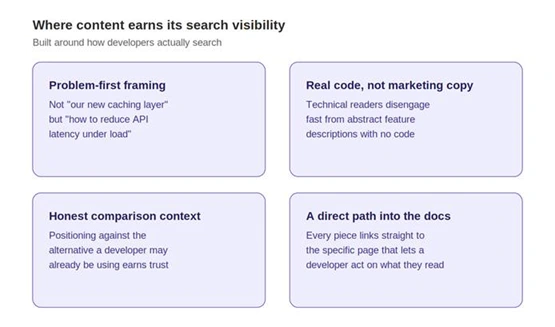
Working with a technical content marketing agency that understands both the writing and the SEO and distribution side means content isn't just published and forgotten. It's built to actually surface in the searches developers run when they hit the exact problem a feature solves, which is a meaningfully different skill set than general content marketing.
Where Documentation and Content Actually Meet
The best adoption playbooks do not regard documentation and content as separate activities carried out by different people according to their own schedules. A feature launch works most effectively when both of these elements are developed as a single, interconnected system.
- The blog post or launch announcement links directly into the relevant documentation page, never into a general docs homepage that leaves the developer to search again.
- The documentation page itself links back out to a deeper guide answering the "why would I actually use this" question the reference material was never designed to answer.
- Both are published on or before launch day, not documentation first and content "sometime after," which is the most common sequencing mistake in fast-moving product teams.
- Both are written by people who understand the underlying implementation well enough to be specific, not by someone reformatting a product brief.
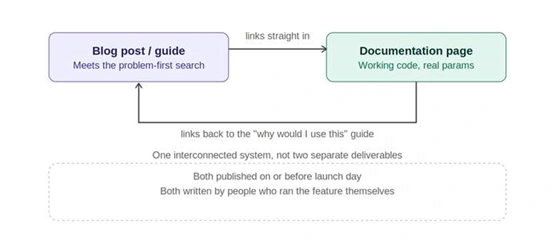
It is this tight loop that causes a routine changelog entry to become something that developers actually attempt. If either of the two steps is omitted, a structural gap results: there would be content with no useful destination for its traffic, or documentation with no reliable means for developers to find it initially.
What This Looks Like in Practice
Imagine a typical situation: a company that makes DevTools launches a new webhook system for the purpose of delivering events in real time. The engineering work itself is of a good standard. However, on the day the system goes live, the only public record is a single line in the changelog stating "Added webhook support." Three months after that, adoption remains at the same level, and the support team is being asked over and over again about the basic setup.
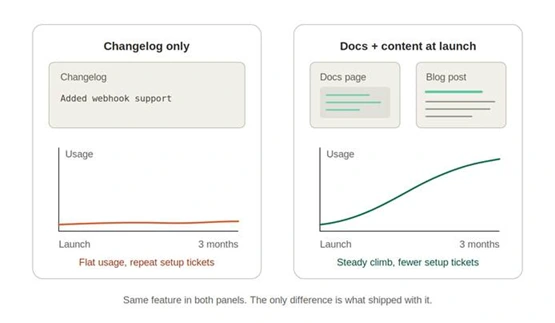
Illustrative example — usage and support-ticket volume shown here are for demonstration, not measured data.
Take that and contrast it with a launch in which the same feature is released together with a documentation page containing a working code example in three languages, clear instructions regarding how to retry and handle failure, and a companion blog post that is titled around the actual problem it solves, an issue that a developer would really search for when their existing polling setup begins to fail. The feature is the same in both cases. The adoption curve is not.
Conclusion: Adoption Is a Content Problem Before It's a Product Problem
The feature itself rarely determines whether developers adopt it. What determines adoption is whether a developer can understand the feature fast enough to try it, and whether they ever hear about it at all in the first place. Documentation handles the first part. Content handles the second. Both need to be built with the same rigor and the same hands-on understanding of the product as the feature they're supporting, not treated as a formality to clear before the launch email goes out.
Teams that fund documentation and content as part of the initial launch, rather than having to produce it afterward when adoption slows down, always have a shorter curve for adoption and a lighter long-term support burden.